Build autonomy. Keep control.
Describe a process in plain language. Boundlane designs it against your systems, proves it safely in shadow mode, and runs it with approvals, auditability and hard limits.
- Trigger
- invoice_matched
- Tools
- 5
- Config
- ap-tolerance
- Approval
- ap_manager
- Forbidden
- change_bank_details
- Stage
- shadow
Automation breaks down when process knowledge, engineering and governance are separated.
The knowledge lives with the people who run the process, the implementation lives in an engineering backlog, and the controls arrive last. Boundlane keeps all three in one versioned system.
Lives in documents and in the heads of the people who run the process.
Captured as versioned requirements, rules and exceptions the automation is built from.
Every change queues behind an integration backlog.
The implementation is generated against the systems you connected, and proved before it ships.
Prompts and access tokens get treated as controls.
Policy is enforced outside the model, and every effect is recorded.
Reads your process documents and the structure of the systems you connect. Records the rules it learns, and asks when a fact it needs is missing rather than assuming one.
Writes the workflow, the tools and the guardrails, then tests them against scenarios and against cases that already happened. It cannot go live until that passes.
Executes under policy, routes approvals and exceptions to the right people, and turns what the runs reveal into the next version.
Two surfaces over one versioned package. Boundlane Studio builds it and proves it; Boundlane Control runs it under policy. The package that passes the gate is the package that executes — pinned by hash, and refused at runtime if the bytes changed.
See what every automation can do — and why.
Each automation brings its workflow, rules, approvals, rollout stage and run evidence together in one reviewable place.
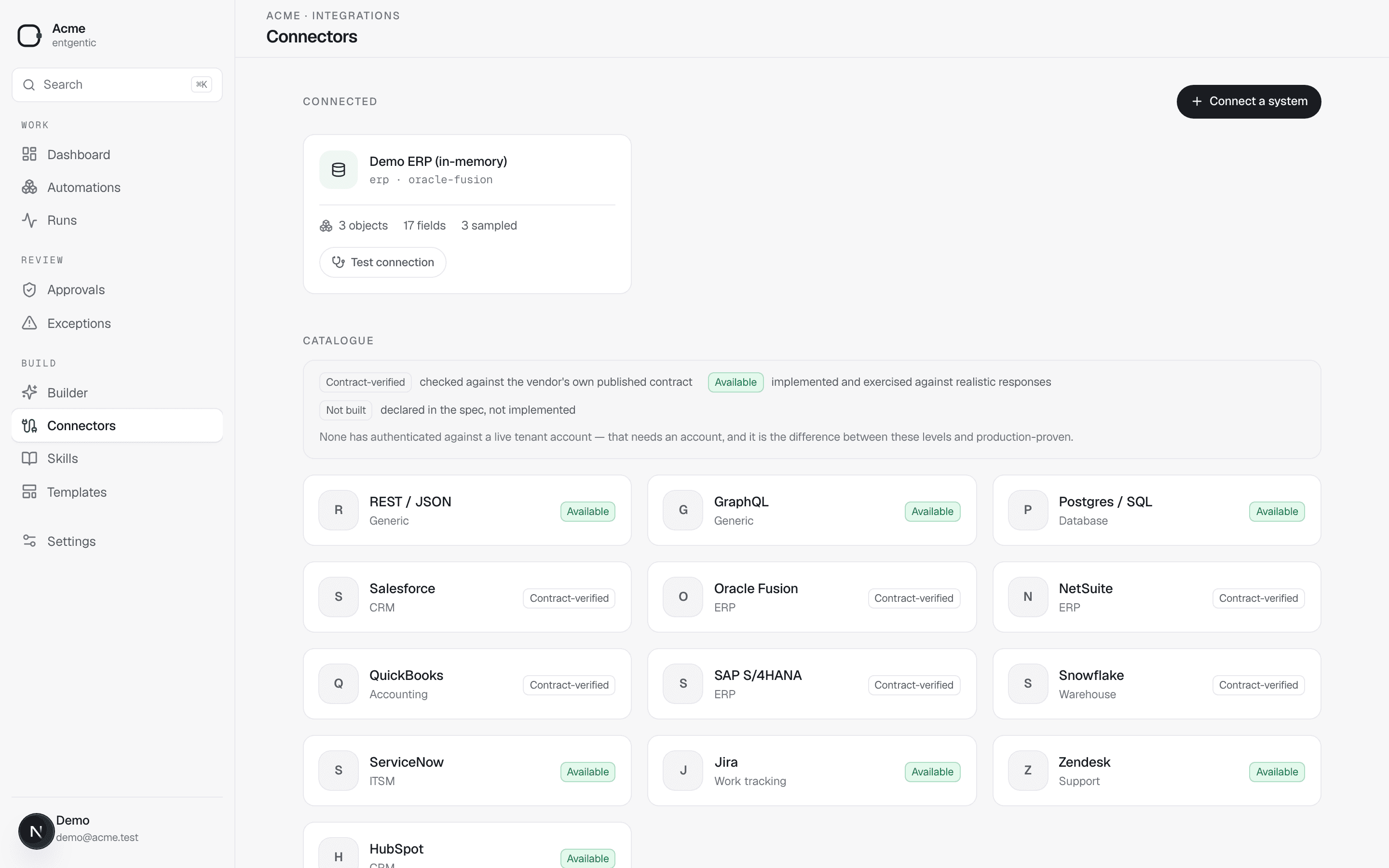
Connect a system and it gets read, not configured.
Connecting reads the real objects, fields and picklist values into a context graph — three objects and seventeen fields here. That graph is what the agent designs against, which is why it cannot invent a field you do not have.
Taken from the running product, not a mockup.
Governance enforced outside the model.
The model can propose an action. Only Boundlane’s policy layer can authorise what reaches your systems, and it decides the same way whatever the prompt says.
- Forbidden actions never execute, in any rollout stage
- Per-tenant secrets, envelope-encrypted; the master key can live in a cloud KMS
- Row-level isolation across every tenant query
- Hash-chained audit trail; the chain head can be anchored outside the platform
This holds in every rollout stage, including GA, and no approval can override it. An action on the forbidden list is not gated — it is absent.
- What did it do?
- Why was the action allowed or refused?
- Who approved it?
- Can the effect be reversed?
Built for high-consequence work across the enterprise.
Each domain carries its own vocabulary, its own approval roles, and its own list of actions an automation may never take. The guardrails change with the function; the way they are enforced does not.
Finance operations
Invoice matching, reconciliation, close tasks, supplier and payment workflows.
Never releases a payment
IT operations
Access requests, incident triage, provisioning, change management and service desk flows.
Never disables multi-factor authentication
HR operations
Onboarding, offboarding, case management and the records that follow a person through them.
Never changes bank details
Revenue operations
Lead routing, quote approval, renewals, territory and pipeline hygiene.
Never grants admin access
Customer support
Ticket triage, entitlement checks, escalation paths and refund review.
Never deletes an audit record
Custom domain packs
Define your own vocabulary, business roles and hard limits. Everything else on this page works the same way.
Never exports records in bulk
Horizontal reach and vertical depth, without the trade between them.
QuantumBlack, AI by McKinsey, publishes an enterprise agentic-platform architecture that frames the two as opposites: horizontal assistants scale easily but sit loosely on the process, while workflow-embedded systems are transformative and narrow. Boundlane is horizontal in distribution — anyone across the functions above describes a process in plain language — and vertical in output, because each automation is built against that system’s real schema and runs under that function’s own approval roles and forbidden actions. Read against their diagram, it matches three of the four agentic-system archetypes and is also the shared-services layer beneath them. The fourth archetype, frameworks for developers building custom agents, is not ours — and is named there as one of the boxes we decline.
Where Boundlane sits, box by boxAn independent reading of a published architecture. Not an endorsement, partnership or affiliation.
Turn one process into a governed automation.
Start in shadow. Learn from real cases. Promote only when the evidence supports it.